
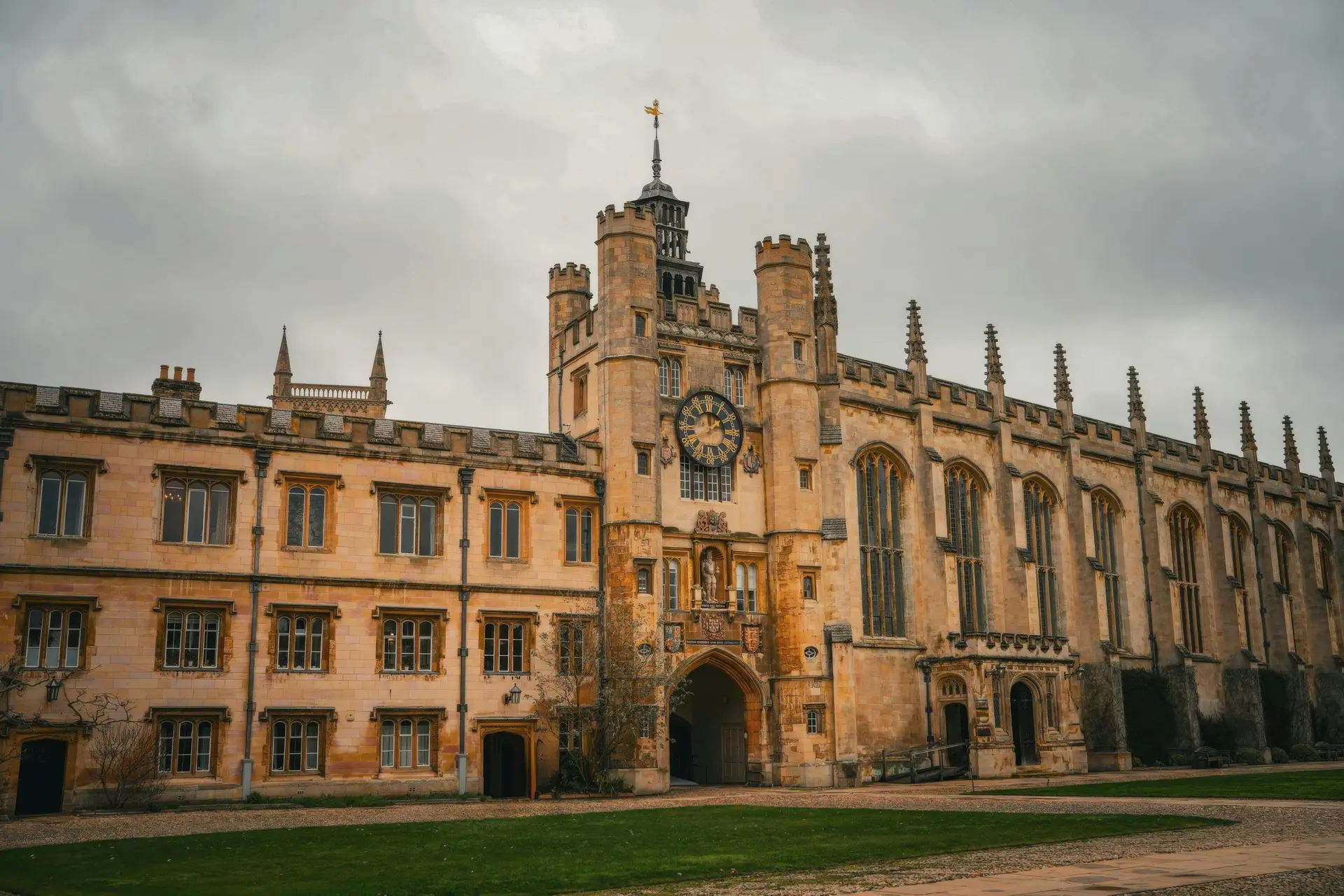
Oxford, Cambridge and selective UK universities
Every serious applicant already has the grades.
What separates them is how they think, and that is the one thing the UK admissions system is built to test.
Request an assessmentOxford and Cambridge
A deadline in mid October, a subject test for most courses, and interviews that decide it. The most demanding undergraduate application in the country, and the one least like anything a school prepares for.
What Oxbridge asks →Other selective UK universities
Imperial, LSE, UCL, Durham, Edinburgh, Warwick, Bristol, St Andrews. One statement carried across five courses, admissions tests for some subjects, interviews for a few.
How the wider application works →Grades get you read. They do not get you in.
The most selective UK universities have far more excellent applicants than places, and predicted grades do not separate them, because everyone in serious contention already has them. What decides these applications is something grades cannot show. Can a student build an argument and defend it? Follow a question they cannot immediately answer? Show genuine, specific interest in the subject itself, rather than in the university’s name?
That is the skill the whole UK process is built to reward, and few school systems anywhere set out to teach it. It is also completely learnable, given the right preparation and enough time.


Our team
Strategists who have been in your position.
Most school counsellors have never been through this process themselves. Every Clavis strategist has: each read their subject at Oxford or Cambridge and has years of experience guiding students through it. That is the basic requirement, not the achievement.
Every student works with one strategist, from the first conversation to the last. Specialists join for particular tasks, but the relationship and the strategy never change hands.
Four pieces of work, whatever the target
Every student’s programme is built around their subject, their goals and their individual strengths, never a fixed package off a shelf.
Course and university strategy
Course choice shapes everything that follows, and it is made before a word is written. We assess a student’s profile against what each course actually rewards, then build the list around it, researched course by course rather than chosen from a league table.
Five choices have to work together as one list, and at most one of them can be Oxford or Cambridge. For international families we also check that qualification equivalencies and subject prerequisites are properly understood before anything is submitted.
- Course and subject selection
- Profile assessed against what each course rewards
- A five-choice list built to work as a whole
- Qualification equivalency checks
Before a course is chosen
League tables answer none of these. The syllabus, the reading list, and someone who studied the course do.
Personal statement
UCAS has replaced the single essay with three questions inside the same 4,000 characters. Tutors read it as evidence of how a student thinks about their subject, not as a catalogue of achievements.
We work one to one on reflection, structure and evidence until the statement reads like the student and nobody else: the book that changed their mind, the problem they could not leave alone, the argument they found unconvincing and why. Our guide to the UCAS personal statement covers the fundamentals.
- Reflection and discussion sessions
- Structure and argument development
- Draft reviews and written feedback
- Reading lists and set independent work
The statement, 2026 entry onwards
How you split them is a strategic choice. Examples
Admissions tests
Each course requires a different paper, published guidance is thin, and target scores are rarely stated. Several are new enough that very little past material exists. This is one of the most common pitfalls on the path to an offer.
Registration deadlines fall weeks before the tests and are the family’s responsibility rather than the school’s, so we make sure nothing is missed, then prepare students for the specific paper their course demands: the TMUA, STEP, ESAT, TARA, UCAT and LNAT among them.
- Which tests a student’s list actually requires
- Registration deadlines tracked
- Strategy and target scores
- Mock tests under timed conditions
Which test, 2027 entry
Interview
An interview is closer to a sample tutorial than a test. A student is handed unfamiliar material and asked to think aloud, and is rewarded not for producing the right answer but for reasoning openly: saying “I am not sure, but here is how I would approach it” and building on a correction rather than defending a lost position.
That runs against the grain of how many students have been taught to perform, and in our experience it is the commonest reason outstanding international applicants are turned down after interview. We build the ability over months, because it is not something that can be fixed in a week.
- Question dissection
- Mock interviews
- Real time feedback
- Set independent work
From our Economics question set
Sunbathers are spread evenly along a beach one kilometre long. Two ice-cream vans sell the same product at the same price, and each sunbather walks to whichever is nearer. Where do the vans end up, and is that efficient?
Tests whether a student can reason to an equilibrium from nothing, then ask whether it is a good one.
The same system, three very different levels of scrutiny
Every UK application runs through UCAS, so the machinery looks identical wherever your son or daughter applies. What changes is how hard each part is read, and how much of the decision rests on it.
| Most UK universities | Highly selective UK | Oxford and Cambridge | |
|---|---|---|---|
| Achievements outside the classroom | Some weight | Minor | No weight |
| Personal statement | One statement across five choices, read for fit | The same statement, read closely for subject depth | A sustained argument for one subject |
| Admissions test | Rare | Law, medicine, maths and the sciences | Required for most courses |
| Interview | Rare outside medicine | Medicine and a handful of courses | Required, academic and decisive |
| Application deadline | Late January | Late January, mid October for medicine | Mid October, whatever the subject |
Most families are somewhere across two of these columns
A realistic five-choice list usually spans them, which is why we do not treat Oxbridge preparation and wider UK preparation as separate products. The work is the same work, done to a different depth.
Oxford and Cambridge
What Oxbridge asks that no one else does
Thousands apply and around 85% are turned down. Almost every one of them has the right grades and the right test scores. Oxford and Cambridge assess one thing: a student’s intellectual fit for the subject they wish to study.
Our son has received his Cambridge offer, and I would like to express my deepest gratitude for everything you’ve done for us throughout this process. The amount of anxiety and stress you’ve saved us from is immeasurable, and your advice and guidance were invaluable. I will, of course, recommend you to everyone who wants the best for their child.
PhilipParent · Hong KongOffer: Human, Social, and Political Sciences, Cambridge
Applicants per place
Oxford, 2023 to 2025 average. Full statistics
Only at Oxford and Cambridge
Three months earlier than the rest of UCAS, with the test and the statement finished by then.
And hardest of all from abroad
Every difficulty a UK applicant faces is heavier for an international one: a different school system, a school that has never sent a student to Oxbridge, and counsellors trained for another country’s admissions entirely. This is the work Clavis was built for, and our strategists made these applications themselves.
Oxford
Cambridge
Sources: Oxford and Cambridge Admissions Statistics Reports (2026).
The wider UK application is different, not easier
We work across the full range of UK universities, with particular depth in the most selective: Imperial, LSE, UCL, Durham, Edinburgh, Warwick, Bristol and St Andrews among them. These applications turn on a different set of pressures from Oxbridge, and families who assume they are simply a softer version of the same thing tend to under-prepare the parts that actually decide them.
Where these applications are won and lost
One statement, five courses
This is the constraint Oxbridge applicants feel least and everyone else feels most. A single statement is sent to all five choices, so a list spread across different subjects forces the statement to be vague in exactly the place it needs to be specific. Building the list and building the statement are therefore one job, not two, and doing them in the wrong order is the most expensive mistake we see.
Tests only where they apply
Most UK courses require no admissions test at all. They are concentrated in law, medicine, and mathematics and the sciences. Part of our work is establishing early exactly which of a student’s five choices require a paper, because registration closes weeks before the test and no school is obliged to tell you.
Offers, firm and insurance
Once offers arrive the decision is strategic: which to hold firm, which to keep as insurance, and how much grade risk a family is willing to carry into results day. We work through that with you, and we do not disappear once the application is submitted. What to do on results day covers the outcomes we prepare for.
Applying from abroad
Qualification equivalencies, subject prerequisites, English language requirements and earlier deadlines for some courses all fall to the family rather than the school. Few schools anywhere, local or international or British curriculum, are equipped for all of it. We are, because most of our team made this application themselves.
We are selective because we are honest.
Oxford and Cambridge are not for everyone, and anyone who tells you that the right preparation gets any student in is lying to you, and to themselves. If we do not believe a place is achievable, we say so plainly.
That is rarely the end of the conversation. For most students the right answer is a different university, often one that suits them considerably better, and we are glad to help them look there. We do not sell admission, we make no guarantees, and we do not quote acceptance rates. What we commit to is the quality of the preparation, the honesty of the advice, and the continuity of care from beginning to end.
What actually happens
01
A conversation
Where the student is, what stands in the way, and what their chances genuinely are. We look at grades, motivation, engagement with the subject, and how they express themselves.
02
A recommendation
Tailored, always. We do not sell one-size-fits-all packages, because focus and duration depend entirely on the student.
03
Work begins
Structured around the student’s existing commitments and the deadline they are actually working to.
04
Continuous support
We are reachable whether or not a session is scheduled, and we do not stop at submission.
05
Results
We celebrate offers together and help handle disappointment. Rejection is never ruled out. For those who get in, we help them arrive ready.
Also included, throughout
Intellectual development
Deepening a student’s engagement with their subject well beyond what the application itself requires.
Support between sessions
Reachable whether or not a session is booked, and we do not stop after the interview.
Parent check-ins
Regular feedback on where your son or daughter stands and what is coming next.
Offers, and what families said afterwards
Realised potential, in his own words
Jim applied from China for Physics: an unfamiliar system, an unfamiliar interview format, and a strategist who had sat exactly that interview.
I’m keeping my promise to let you know that I received my conditional offer from Trinity College, Cambridge! Thank you so much for your tutoring, I appreciate all our pleasant talks. Thank you again for your support. I hope to see you in Britain!
You were an outstanding mentor to our son over several years. In that time, he made significant progress in understanding his own interests and became far more engaged, both in his studies and beyond them. A special thank you for your support through the application process.
The interviews, you helped so much. It was scary, but thanks to our sessions I knew what to expect and felt more in control and less stressed. I definitely would’ve struggled without your help preparing.
Thank you for all the help through the application process. I just received my first offer from LSE for Accounting and Finance, and I genuinely believe your guidance had such a big impact on it.
Start with an honest assessment
Tell us about your son or daughter and where they are in the process. We will tell you what we think, including if we think their current target is the wrong one, in either direction. Prefer to message us? Contact us on WhatsApp at +44 7404 929213; expect a strategist to reply within one working day.
Questions
Frequently asked questions
No. We work with students applying across the full range of UK universities. Oxbridge preparation is the most demanding version of the work, so it is the part we are best known for, but the same four pieces of work decide an application to Imperial, LSE, UCL or Durham, and the same strategist carries a student through either. If your son or daughter is not applying to Oxford or Cambridge, nothing on this page is a lesser service.
The full range, with particular depth in the most selective: Oxford, Cambridge, Imperial, LSE, UCL, Durham, Edinburgh, Warwick, Bristol and St Andrews among them. If you are unsure whether we can help with your son or daughter’s target universities, get in touch and we will tell you honestly.
No, most do not. Tests are concentrated in the most competitive courses: Law (LNAT), Medicine (UCAT), mathematics and the sciences (TMUA, ESAT and others), and a wide range of Oxford and Cambridge subjects. As part of building a student’s strategy we identify exactly which tests, if any, their five choices require, and prepare them accordingly. Oxford retired its own tests from 2026 entry, so any guidance still referring to the MAT, PAT, TSA or HAT is out of date.
Yes. From 2026 entry UCAS replaced the single free-form essay with three questions, within the same 4,000-character limit and a 350-character minimum on each. It changes how the argument has to be built, and examples written under the old format are now misleading. You can see the new structure applied in our personal statement examples.
Most schools handle UCAS administration competently but are not set up for the specific intellectual demands of the most competitive applications: the kind of personal statement admissions tutors respond to, subject-specific tests, and interviews that assess how a student reasons rather than what they have memorised. We focus entirely on that, with a team who went through the process themselves and one strategist who stays with the student throughout.
Every Clavis strategist graduated from Oxford or Cambridge and has extensive experience guiding students through this process. Each is matched to a student’s subject, so your son or daughter works with someone who studied their field at the highest level, not a generalist who understands admissions in the abstract. You can read about our team.
We will tell you plainly. If we do not believe an Oxbridge place is achievable we will say so and we will not sell you Oxbridge preparation. That is usually not the end of the conversation: in most cases a different UK university suits the student better, and we are glad to help them aim there instead. If we do not think we can help at all, we will say that too.
No. The approach, the focus and the duration are individualised for every student. A Year 12 student starting early needs something quite different from a Year 13 student six weeks out from interview. We recommend scope after the initial conversation, and discuss fees then.
As early as possible. The intellectual depth the most selective universities look for is built over years rather than months, and starting in Year 12 leaves room to prepare properly for the test, the statement and the interview. Students who come to us later can still be supported, and we will assess honestly what is achievable in the time remaining.
Yes to both, and international families are a large part of who we work with. Applicants from abroad face every burden a UK applicant faces, amplified: unfamiliar systems, qualification equivalencies, registration steps that fall to the family, and interview logistics. We work primarily online by video call, arranged around your time zone. For families based in London we are happy to arrange in-person sessions where practical.
Start before you have decided where to apply.
The intellectual depth these applications reward is built over years rather than months. A conversation a year out is worth considerably more than one six weeks before the deadline, and it costs nothing either way.
Request an assessment